Darwin and Facial Expression by Paul Ekman
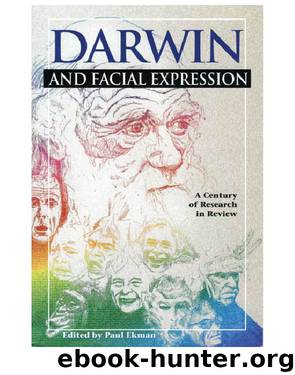
Author:Paul Ekman
Language: eng
Format: epub
Publisher: Institute for the Study of Human Knowledge
Published: 2006-08-07T16:00:00+00:00
4
Cross-Cultural Studies of
Facial Expression [see Note1]
Paul Ekman
University of California, San Francisco
INTRODUCTION
Are facial expressions of emotion the same for all men? When someone is surprised, for example, will we see the same facial appearance no matter what his country, race, or culture? Are facial expressions of emotion unlike verbal behavior, where people in different cultures learn different words for saying the same thing? Is it true that we can understand a foreigner’s emotions if we observe his facial expressions, that we need no special facial language school, tutoring us as to what these expressions mean in each culture?
If facial expressions are universal, does that mean they are innately determined? Is learning unimportant in determining facial expressions of emotion? Does man inherit particular facial muscular movements for anger, and surprise, and sadness, etc.? Is it our genes that determine which facial muscles move when we feel one way or another?
And, if facial expressions of emotion are universal and innately determined, have they evolved with man from his animal progenitors? Are man’s facial expressions of emotion similar to those shown by other primates? Do the principles that explain why our lips turn up rather than down when happy also explain the facial muscular movements of the chimpanzee or the wolf? Does man show these facial muscular movements for emotion because he has evolved from other animal species?
Darwin thought the answer to all these questions was yes. Furthermore, he believed that a positive answer to the first set—facial expressions are universal—necessarily led to a positive answer to the second set—that they are innate. And, if universal facial expressions are innate, a positive answer to the third set of questions may be inferred—that they are the product of evolutionary pressures. We shall not be concerned with this last matter, for Chevalier-Skolnikoff has discussed in Chapter 2 the relationship between the facial expressions of man and the other primates. Instead our primary focus shall be on the first set of questions, the possible universality of facial expressions. We shall see that a positive answer to the question of universality does not necessarily require a positive answer to the question of innateness, as Darwin thought it did, although it does increase the probability that genetic factors are important determinants of facial expression. The question of innateness will not be of major concern to us, for reasons to be explained shortly.
In Darwin’s time, according to his own report, most people accepted the notion that facial expressions are universal, even though there was scanty evidence for such a claim. Darwin obtained some new evidence to prove the universality of at least some facial expressions,[see Note 2] although his methods of study were vulnerable to many sources of error. In the century following Darwin’s book on expression, his views came to be largely ignored, and credence was instead given to those who claimed, with evidence as faulty as Darwin’s, that facial expressions of emotion are specific to each culture and that there are no universals. The dominant view became “what is shown on the face is written there by culture.
Download
This site does not store any files on its server. We only index and link to content provided by other sites. Please contact the content providers to delete copyright contents if any and email us, we'll remove relevant links or contents immediately.
Should I Stay or Should I Go? by Ramani Durvasula(7652)
Why We Sleep: Unlocking the Power of Sleep and Dreams by Matthew Walker(6694)
Fear by Osho(4727)
Flow by Mihaly Csikszentmihalyi(4684)
Rising Strong by Brene Brown(4448)
Why We Sleep by Matthew Walker(4433)
The Hacking of the American Mind by Robert H. Lustig(4372)
How to Change Your Mind by Michael Pollan(4354)
Too Much and Not the Mood by Durga Chew-Bose(4334)
Lost Connections by Johann Hari(4169)
He's Just Not That Into You by Greg Behrendt & Liz Tuccillo(3889)
Evolve Your Brain by Joe Dispenza(3668)
The Courage to Be Disliked by Ichiro Kishimi & Fumitake Koga(3477)
Crazy Is My Superpower by A.J. Mendez Brooks(3394)
In Cold Blood by Truman Capote(3374)
Resisting Happiness by Matthew Kelly(3336)
What If This Were Enough? by Heather Havrilesky(3308)
The Book of Human Emotions by Tiffany Watt Smith(3292)
Descartes' Error by Antonio Damasio(3270)
